
Horsham Sources for Earlier Addresses
Use a source that matches the era and the question. The county assessment record gives a present parcel starting point. The Recorder supplies recorded instruments, while HPHA, county tax lists, confirmed directory volumes, public census releases, and archival material add household or locality evidence for other periods. No source proves every person at an address for every year. A deed tracks a property interest; a tax roll identifies taxable persons; a directory may identify a listed subscriber; and a census records a household in its own enumeration context.
| Source | Years it covers | Where held | What it can show |
|---|---|---|---|
| Recorder documented collection | From 1784 | Public Access System, counter, or mail | Deeds, mortgages, plans, recorded parties, and legal-description leads. |
| HPHA manuscript collection | 1684 to 1975 | PastPerfect catalog and physical holdings | Township and property material, deeds, photos, and local papers; confirm the specific item. |
| Horsham tax roll | 1842 and 1885 | HPHA finding aid | A named taxable-person or property clue. |
| County commissioner tax lists | 1785 to 1789, 1793, 1795 to 1829, 1831 to 1834, and 1834 to 1836 | PHMC county guide and County Archives | Earlier named township taxpayers, with gaps and no modern-address match assumed. |
| Suburban reverse directories | 1929 to present, with gaps | Free Library, after coverage confirmation | Address to listed subscriber in a volume that actually covers the locality. |
| Federal census | Released under the 72-year rule | NARA and library genealogy databases | A dated household and district context, not a present-address record. |
Begin with the parcel and latest recorded deed when the address is modern. For a nineteenth-century reference, begin with tax and property material that fits the date. For a twentieth-century address, seek a verified directory volume and pair it with census, deed, newspaper, or estate evidence. Preserve the date, collection name, and record identifier each time the trail changes sources.
Note: A record’s date and source type matter as much as its name because each source answers a different historical question.
Start a Horsham Parcel Trail
Montgomery County Property Records supports address and parcel-ID searching, but its public interface says owner-name search is no longer available. Search the physical address, select HORSHAM when appropriate, and record the Parcel ID or TAXPIN, site address, alternate ID, sales-date context, and any legal-description or plan clue displayed. The assessment record is a lead. It is not title proof and it does not establish every person who lived at the property. County records update on different schedules, so retain the date you saw the parcel card.
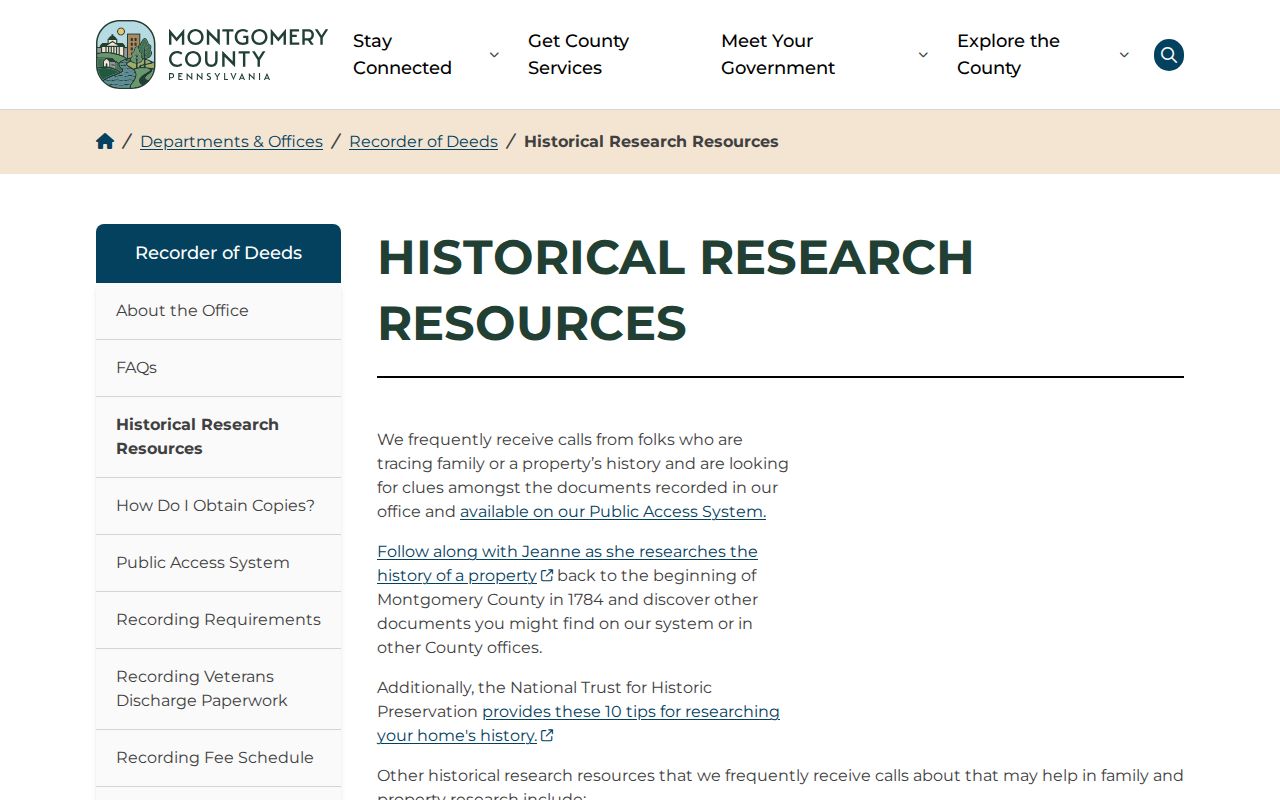
The Recorder’s historical research resources provide the official county route for a house-history project. This Horsham Township address-history image points to that starting place and its referrals to archival and historical research. Use it after you have an address, TAXPIN, or recorded-document detail to anchor the request.
From the parcel card, move to recorded deeds by address or parcel ID. Legal-description and plan language help prevent a same-numbered modern address from being mistaken for the same property.
Trace Past Owners in Horsham Deeds
The Recorder’s index is the core backward address trail because it records property documents and their parties. Create the required free account, choose Search Public Records, and use the address, parcel ID, and name fields named in the office instructions. Start with the latest deed that fits the parcel. Record the grantor, grantee, recording date, book and page or instrument number, legal description, plan reference, and image or copy status before moving to an earlier document. Compare the legal description as well as the address because parcels can split, merge, or change numbering.
- Find the current parcel through the county address search and retain its TAXPIN, site address, and legal-description lead.
- Search the Recorder index by parcel ID or address for the latest deed. Save its parties, date, document reference, and plan or lot language.
- For the next earlier conveyance, follow the appropriate party sequence while checking that the parcel and legal description still match.
- Repeat the dated comparison backward. A mortgage, satisfaction, estate record, or plan may explain a gap without proving a change of household.
- When a remote image is unavailable, use Recorder counter computers, the written mail procedure, County Archives, or historical-society research instead of guessing at an image cutoff.
- Grantor and grantee
- The grantor transfers an interest in a recorded document. The grantee receives that stated interest. Both roles are dated document facts.
- Chain of title
- A sequence of recorded conveyances joined by the property’s legal description, plan, or parcel context.
- Legal description
- The lot, plan, metes, or other recorded property wording that can remain useful when a street number or road label changes.
Note: An unexplained date gap is a reason to check probate, plans, tax lists, and archives, not a reason to assign a past resident from a similar name.
Recorder Access for Horsham History
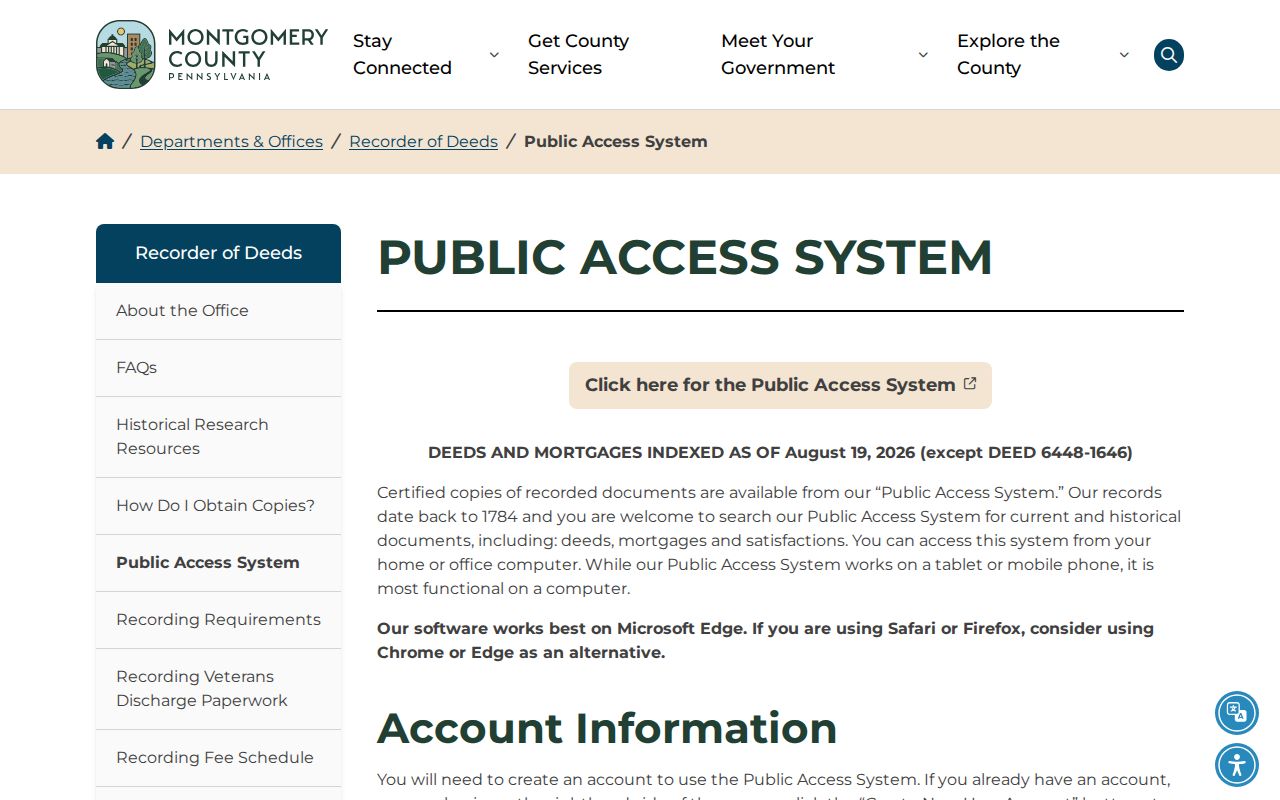
Montgomery County says its permanent land records date to September 10, 1784. The Recorder instructions identify name, address, and parcel ID as search keys for deeds, mortgages, satisfactions, plans, and related recorded material. Index access requires a free account. Remote images have a different tier: the office says they need either a $25 calendar-day subscription or a $300 monthly subscription, and plain images cost 50 cents per page once subscribed. An e-certified document costs $10.50 and is placed in the user’s queue.
The official Recorder Public Access System explains the account and image rules shown in this Horsham Township Recorder image. Counter computers remain available, and written mail copy requests are another route. The Recorder asks mail requesters to give the owner name, address and municipality, parcel ID, or book and page when known, then include the requested fee and a self-addressed stamped envelope.
Those alternatives are important when an index result is clear but the document image is not available remotely. The research did not establish one verified online-image cutoff, so use the office route rather than inventing a year.
Horsham Tax Rolls for Past Residents
HPHA’s manuscript finding aid identifies a Horsham tax roll for 1842 and 1885 within a broader 1684 to 1975 collection. It also lists township records, Graeme Park property material, deeds, correspondence, photographs, and account books. A tax-roll entry can place a named taxable person in a local property context. It cannot, by itself, establish the full household or prove that today’s street number existed in the same form. Pair it with the property description, deed trail, map reference, census, or a verified archival item.
For historical-household help, HPHA’s online archive is searchable through PastPerfect and is hosted at Horsham Township Library. The library can help researchers pursue a catalog result or ask about local material. Search with the surname, road, Horsham, Graeme Park, or a nearby place name, then request the original item’s access conditions before treating a catalog lead as evidence.
The story is local and unusually deep: county land records begin in 1784, while HPHA holds material beginning in 1684. That combination can carry a Horsham property question much earlier than a modern portal, but only record-by-record comparison connects a person, period, and address.
Note: An online archive result identifies a possible item; the repository’s collection details determine whether it supports the specific address.
Horsham County Tax Lists by Era
County commissioner tax lists supply an earlier layer where modern street addresses do not. The PHMC county guide identifies Horsham Township list coverage for 1785 to 1789, 1793, 1795 to 1829, 1831 to 1834, and 1834 to 1836. Those runs have gaps. They should be used as named-householder evidence within a township and period, not as an automatic connection to a contemporary parcel. The reliable bridge is a recorded legal description, map, tract reference, or other dated property detail.
Montgomery County Archives holds historic tax material, pre-1906 birth and death records, departmental microfilm, and related historical links. Its archive records cannot be certified there; certification must come from the original department. For an old property question, give staff the road or hamlet spelling as written, a date range, and the record type. A focused request is more useful than asking for a newly assembled list of people.
Note: County tax-list coverage has documented gaps, so a missing name is not proof that a person was absent from Horsham.
Past Households in Horsham Records
Deeds tell only one part of a past-residents story. The people who appear in a recorded conveyance may not be everyone who lived at the address. For a household layer, look for a confirmed reverse or telephone directory, then pair that listed-address evidence with a public census release, newspaper material, an obituary, or an estate file that fits the same period. The Free Library reports suburban reverse directories from 1929 to the present with gaps. Its collection notice does not prove that every volume covers Horsham, so confirm the title, service area, and year first.
- Place each deed or parcel event on a dated timeline.
- Ask the holding library whether a reverse or telephone directory covers the address for the nearest year.
- Use the directory’s own date and abbreviation key, remembering that the information may reflect the prior year.
- Compare the listed address with the applicable public census district and date, then test the match against deeds, tax lists, newspapers, or estate material.
- For a death or estate endpoint, use the Register of Wills, County Archives, or state historical-vital channel according to the date of the event.
Montgomery County marriage licenses begin in 1885 and are open for viewing according to the county. The Register of Wills and Clerk of Orphans’ Court also handles estates and related probate material. Pennsylvania Vital Records begins in 1906, while County Archives covers pre-1906 birth and death material and the Register has a separate 1893 to 1915 county-birth series. These are date-based custody paths, not broad people searches.
Collection details for reverse directories, library holdings, and historical records are available through the Horsham Township city directory resources when a household trail needs a confirmed volume rather than a general date range.
Note: A directory entry may reflect the prior year, so pair it with a dated deed or census record before drawing a timeline conclusion.
Horshamville Address Continuity
Horsham’s older roads and settlement names can interrupt an otherwise careful address-history search. Township history says early survey lines shaped County Line, Horsham, and Welsh Roads. It identifies Horshamville near Horsham and Easton Roads and explains that expansion of Willow Grove Naval Air Station closed Keith’s Road and Privet Road and absorbed the hamlet. A historic record may therefore refer to a road or locality that does not map cleanly onto today’s mailing address.
When that happens, do not force a current address into an old source. Work from the deed’s legal description, lot or plan reference, historic road name, tax list, map, and archival property material. A parcel split or changed number can be the missing link. That cautious method protects the chain from a false match based on a familiar street name.
Note: Preserve the old road or hamlet wording exactly because it can be the key to a later map or archival search.
Horsham House History Help
The most useful help comes from the custodian closest to the record. Use the Recorder for an instrument or copy procedure, County Archives for its archival series, the Register for estate or county marriage material, and the Township for existing municipal files. Use HPHA, Horsham Township Library, and the Historical Society of Montgomery County after an official record supplies a date, road, property description, or name that needs context. HSMC has county tax records, microfilm, family files, religious records, newspapers, cemetery material, directories, deeds, and naturalization sources; contact it ahead for archival pulls.
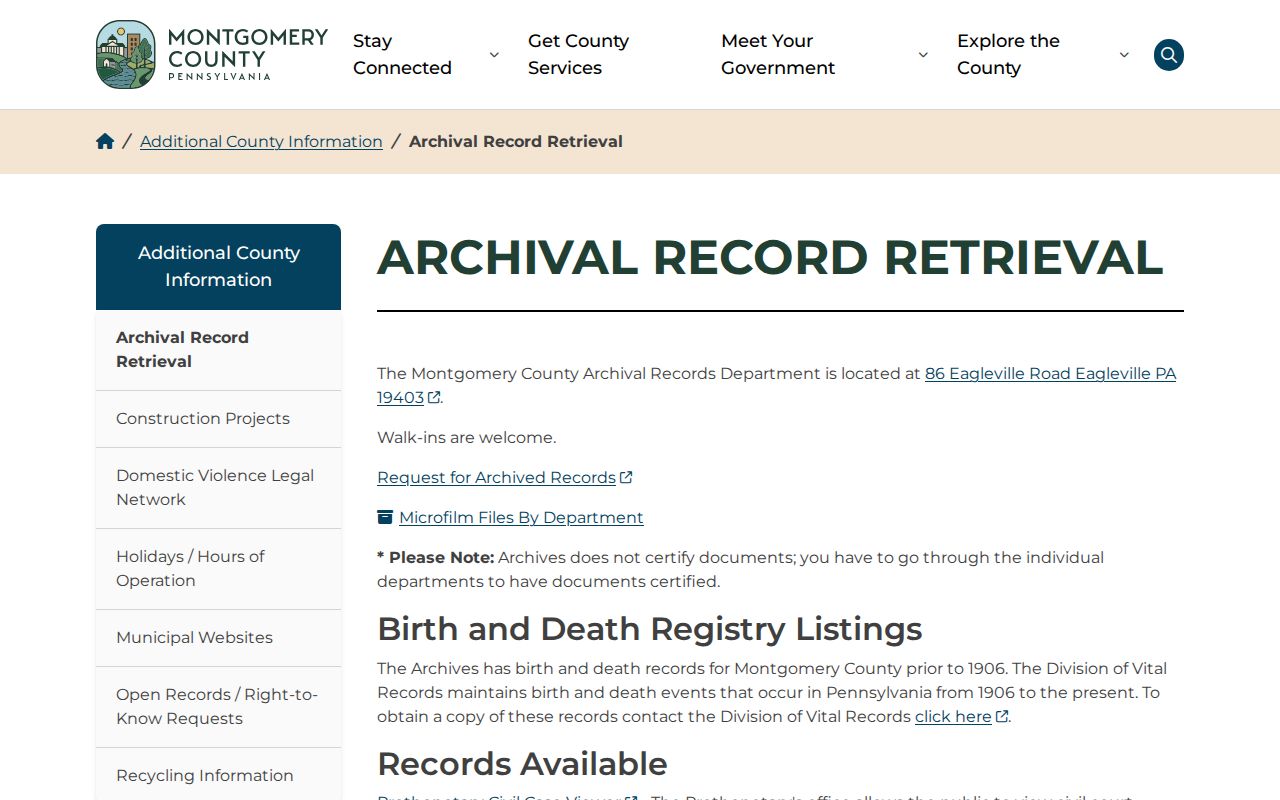
The Montgomery County Archives retrieval page identifies the archival channel for older local records. This Horsham Township archive image represents the official archive route, including its historical links and walk-in research information. Bring the exact source wording, date span, and known road or hamlet to make the request reproducible.
A research note should retain the repository, collection or call number, page or image reference, search date, and the specific fact supported. That separates an archival lead from a documented address connection.
Horsham Address History Limits
Past-residents research is best used for house history, family history, estate questions, and a careful record of a property over time. Records can be incomplete, protected, or tied to a similarly named person. A current parcel account, recorded deed party, tax entry, census listing, archive catalog, or directory listing has a different meaning. Keep the source label with the conclusion and seek the original custodian when a copy, correction, or access decision is needed.
Lawful use. Use historic Horsham Township address records for personal and lawful research. Do not use a name, address, or historical record to stalk, harass, intimidate, or harm another person.